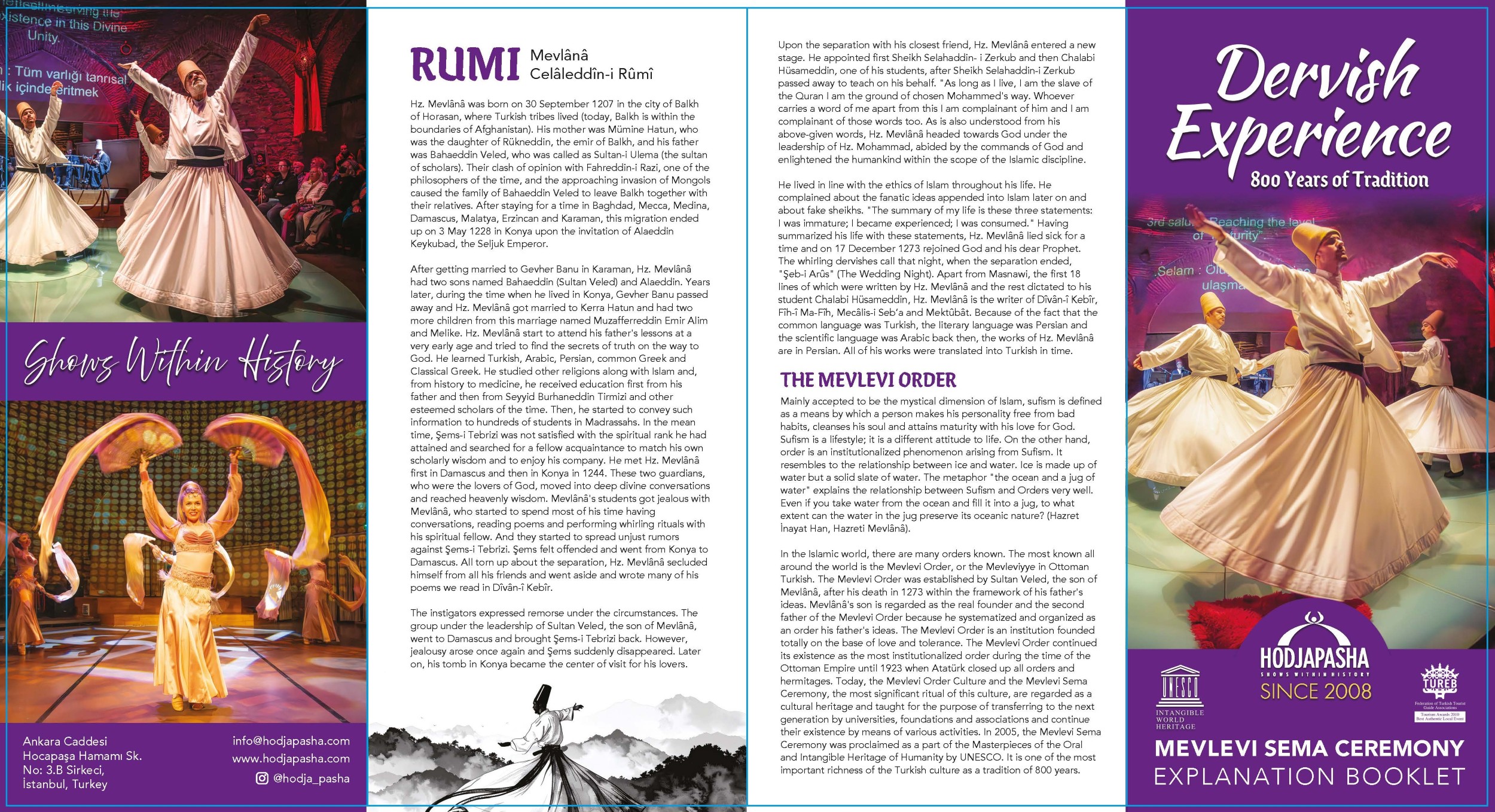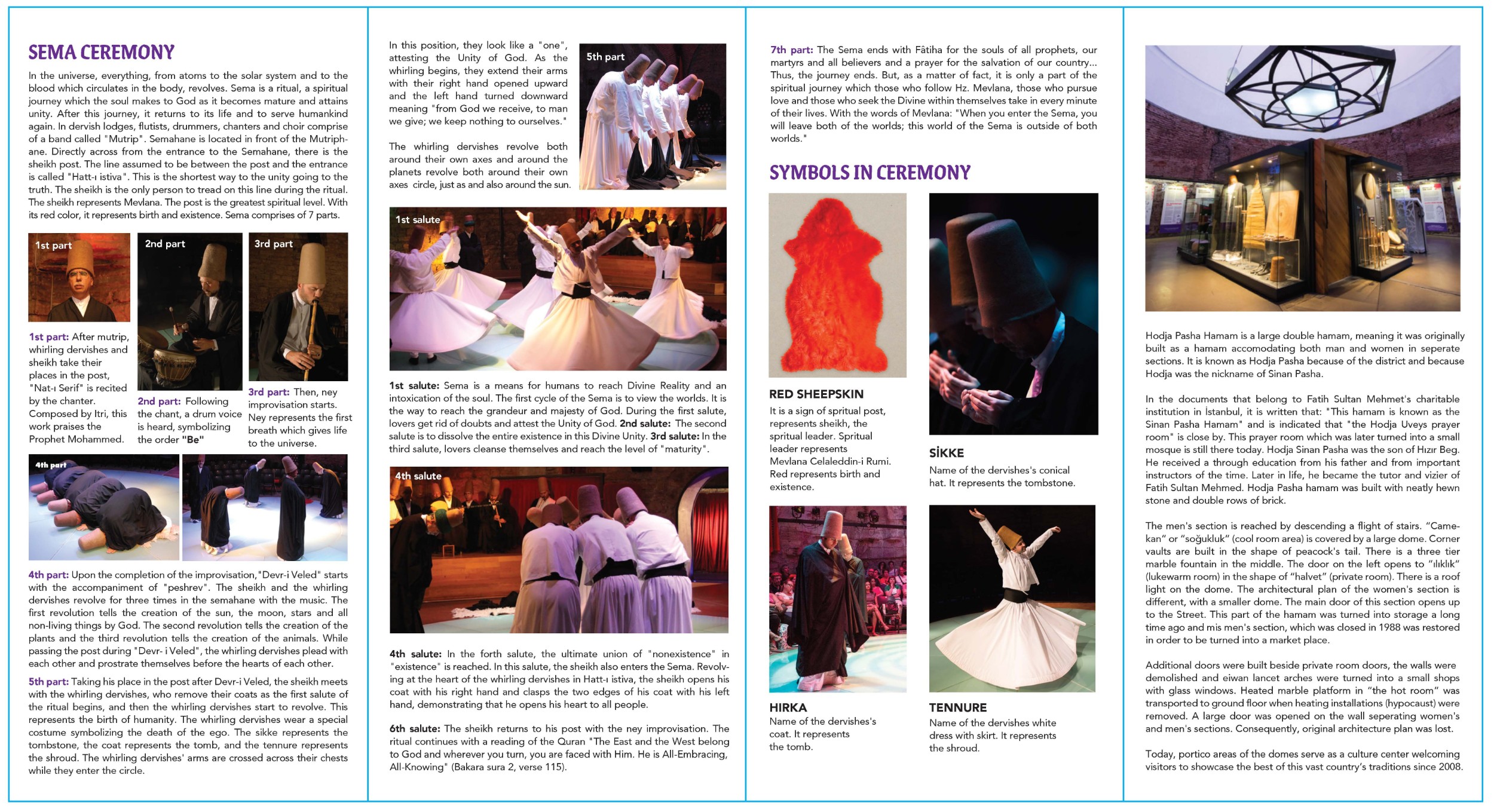

The name Mevlana Celaleddin-i Rumi stands for Love and ecstatic flight into the infinite. Rumi is one of the great spiritual masters and poetical geniuses of mankind and was the founder of the Mevlevi Sufi order, a leading mystical brotherhood of Islam.
Rumi was born on 30 September 1207 in Balkh in present day Afghanistan to a family of learned theologians. Escaping the Mongol invasion and destruction, Rumi and his family traveled extensively in the Muslim lands, performed pilgrimage to Mecca and finally settled in Konya, Anatolia, then part of Seljuk Empire.
When his father Bahaduddin Valad passed away, Rumi succeeded his father in 1231 as professor in religious sciences. Rumi, 24 years old, was an already accomplished scholar in religious and positive sciences. He died on 17 December 1273 in Konya in present day Turkey. He was laid to rest beside his father and over his remains a splendid shrine was erected. The 13th century Mevlana Mausoleum continues to this day to draw pilgrims from all parts of the world.
The Saint of Love
The Exalted Mevlana is a saint of love: he gave his heart to the Creator and he taught us to speak always of love and to love all creation as being from the Creator. He asks:
“If you fill a jug from the ocean, how much can it hold? One day’s supply.”
Mevlana is beyond the highest and finest conception. He said: “Be a lover, a lover. Choose love that you might be a chosen one.”
To give up one’s own existence and become non-existent in God is the shortest way to God. Whoever has given his heart to the Divine Truth has no “self” left. He has become enfolded in the moral principles of God.
The Message of Rumi
Mevlana is an illustrious being, a spiritual sun who brought a brand new message to human thinking. The greatest message he brought is Love, Divine Love and Unity. He rejects nothing but rather unites, perfects and causes love. He is prejudiced toward none because he knows that everything is the manifestation of God.
“Man is the most honorable of all creation” is one of his maxims. He embraced those of every language, creed and race; he is the symbol of peace, brotherhood, and tolerance.
Seb-i Arus (The Wedding Night)
The night of 17 December is the holiest in the Mevlevî calendar, a night of union, a wedding night (Şeb-i Arus), when Mevlana departed the mortal world to become one with the Beloved. It is not a time to mourn but to rejoice. Each year thousands of people travel to Konya in response to Mevlana’s call:
“Come, come again, whoever you are, come!
Heathen, fire worshipper or idolatrous, come!
Come even if you broke your penitence a hundred times,
Ours is the portal of hope, come as you are.”
Sufi Tradition & Mevlevi Order
Sufism is a mystical Muslim school of thought and aims to find love and knowledge through direct personal experience of Allah. Many Sufi orders exist across the Muslim world; Sufis are “mystics” on the path to the Beloved (God).
The Mevlevi order was founded in 1273 by Rumi’s followers after his death, particularly his son, Sultan Veled Celebi, in Konya. During the Ottoman period, the Mevlevi order spread into the Balkans, Syria, and Egypt. Music, especially the ney, plays an important part in the Mevlevi order.
The Mevlevi Sema Ceremony
The Mevleviye are known for their practice of whirling dances. At their ceremonies, or Sema, a particular musical repertoire called ayin is played. The Mevlevi Sema Ceremony was proclaimed as an Intangible World Heritage by UNESCO in October 2005.
From a scientific viewpoint, the fundamental condition of our existence is to revolve. Everything revolves—from atoms to the planets. The “whirling dervish” or Semazen causes the mind to participate in this universal revolution.
The Seven Parts of Sema
- First Part: Starts with “Nat-i Serif” (eulogy to the Prophet). The dervish removes his black cloak, symbolizing a spiritual birth to the truth.
- Second Part: A drum voice symbolizing the Divine order: “Be.”
- Third Part: An instrumental improvisation (taksim) with the reed flute (ney), representing the Divine Breath.
- Fourth Part: The dervishes’ greetings (Devr-i Veled), symbolizing the salutation of soul to soul.
- Fifth Part (The Whirling): Consists of four salutes (Selams):
- 1st Salute: Man’s birth to truth through mind.
- 2nd Salute: Witnessing the splendor of creation.
- 3rd Salute: Sacrifice of mind to love and complete submission (Fenafillah).
- 4th Salute: Return to the task in creation and service to humanity.
- Sixth Part: Reading of the Quran (specifically Sura Bakara 2, verse 115).
- Seventh Part: A prayer for the repose of the souls of all Prophets and believers.